More than $5.6 billion was wagered on the 2026 World Cup final through Polymarket and Kalshi, representing just a sliver of the overall action on prediction markets — a legal but controversial way to gamble on the outcome of almost anything.
The latest installment of Instadocs, now streaming, examines the phenomenon, exploring how tens of millions of people are diving into these markets — placing bets on anything from the World Cup and Taylor Swift’s wedding to elections, weather, and armed conflict — with all sorts of consequences.
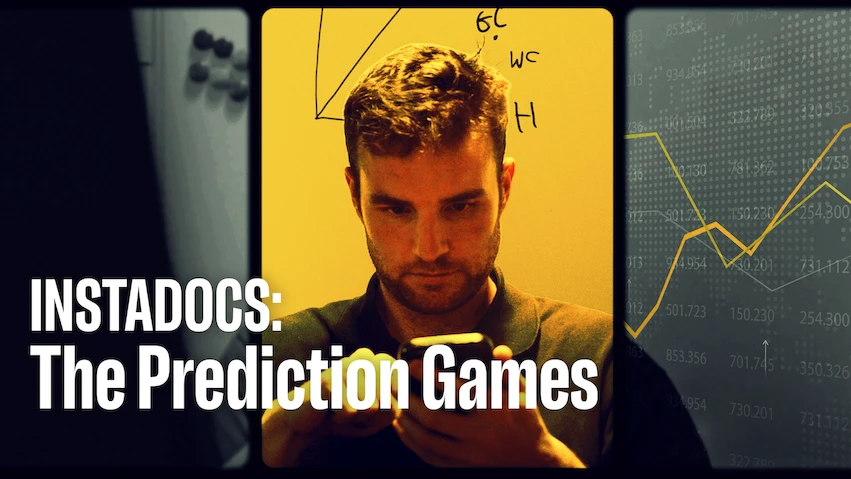
Here’s everything to know about Instadocs: The Prediction Games.
What is Instadocs: The Prediction Games about?
Instadocs: The Prediction Games drops viewers into the red-hot center of betting fever, where millions are wagering they can predict the future and win big — fast. The installment features interviews with those who own the game, including Polymarket CEO Shayne Coplan and Kalshi CEO Tarek Mansour, as well as regulator Michael Selig, head of the Commodity Futures Trading Commission.
Prediction markets are a deceptively sophisticated idea, with roots far back in American history. But the allure of easy money can carry real risk: when bettors harass war reporters to publish fake news and hackers manufacture Spotify streams to win millions, has reality itself become a target for manipulation? Has the wisdom of crowds turned into mob rule?
When is the documentary release date?
Instadocs: The Prediction Games premiered on July 26. Stream it now.
Who’s interviewed in Instadocs: The Prediction Games?
The documentary features interviews with:
- James Surowiecki, author, The Wisdom of Crowds
- Tarek Mansour, CEO of Kalshi
- Dustin Gouker, journalist
- Michael Selig, Chairman, CFTC
- Shayne Coplan, CEO of Polymarket
- Robert DeNault, Head of Enforcement, Kalshi
- Caleb Davies, whistleblower
- Emanuel Fabian, journalist
What is a prediction market? What are the key terms?
Below, Instadocs executive producer Josh Tyrangiel breaks down the language of prediction markets:
“Prediction markets are one of the fastest-growing industries in the United States, with Wall Street analysts forecasting more than $1 trillion in annual trading volume by 2030. The numbers are astonishing. But the words are kind of a mess.
Spend a few minutes on Kalshi or Polymarket and you’ll run into phrases borrowed from Wall Street, terms cribbed from Las Vegas, and language that doesn’t make sense in either place. That’s no accident. The arguments about prediction markets — in courtrooms, in Congress, and throughout The Prediction Games — are really fights about what to call things. Is an event contract a bet? Is a trader a gambler? Is the person who puts millions on the World Cup final an investor, a speculator, or an addict?
The good news: None of this is actually that hard. Learn these terms and you’ll understand not just what everyone is saying, but what they’re really fighting about. In prediction markets, the vocabulary is the argument.
Prediction Market — A marketplace where people trade contracts on the outcome of real-world events — from ordinary things like who wins an election or the World Cup to extraordinary things like whether scientists will confirm the existence of alien life by a certain date (yes, that’s a real market).
The genius of prediction markets is that they turn opinions into prices, and prices — unlike opinions — tend to keep people honest. It’s easy to declare that you’re certain about something. People think twice when their money is on the line. Which may explain why “Aliens confirmed” trades at 3 cents: millions of people say they believe in aliens, but only 3% of their wallets back them up.
Event contract — The basic unit of a prediction market: a contract tied to a single question with a verifiable answer, paying a fixed amount if the event happens and nothing if it doesn’t. Think of it as a coin with two sides — “Yes” and “No” — and somebody owns each one.
Wisdom of crowds — The idea that large groups can collectively outpredict almost any individual expert. A classic example is guessing the number of jelly beans in a jar: Most people guess wrong, but the average of hundreds of guesses often lands shockingly close to the truth. Prediction markets are like the jelly-bean jar — with money on the line. Every trade is a tiny piece of information, and the price is the running average.
Sportsbook — A sportsbook doesn’t just host bets — it takes them. Every wager goes onto the bookmaker’s own balance sheet, and the bookmaker earns money through the vig, the small built-in edge it has on every bet.
A prediction market works differently. It matches buyers with sellers and collects a fee for hosting the trade. It doesn’t care who wins. That difference is why sportsbooks are generally regulated as gambling while prediction markets like Kalshi and Polymarket argue that they’re financial exchanges.
Casino — Casino games are contests of chance. No amount of knowledge about the world changes where the roulette wheel lands next. Prediction markets are almost the opposite. Information is the only edge there is.
Stock market — A stock is an ownership stake in a company. The value can compound for decades and, barring a sale or bankruptcy, never fully resolves. A prediction contract is a bet on one question with an expiration date and a definitive answer: The event happens or it doesn’t, the contract pays $1 or $0, and then it’s over.
Sharp — A trader with an informational or analytical edge. Their bets push prices toward the truth. A sharp isn’t someone who wins a lot; a sharp is someone the market learns from. Sports books limit or ban them because sharps tend to beat the house — but prediction markets need sharps, because sharps are how the prices get smart.
Whale — A trader whose positions are big enough to move a market. In thin markets, a whale can briefly make an unlikely outcome look likely. Whether that’s conviction or manipulation usually depends on what happens next — when other traders decide whether to follow or take the other side. If you have to ask whether you’re a whale, the answer is almost certainly no.
Hedge — A position that pays off if something bad happens to you — a farmer buying “Yes” on drought, or an airline buying protection against higher fuel prices. Many trades in prediction markets aren’t really gambling at all; they’re glorified forms of insurance. The same contract that’s a bet for one person can be protection for someone else.
Resolution — The finish line in any prediction market — the moment someone gets paid. That’s easy when the event is an election or a football game. It’s harder when the outcome depends on interpretation. A famous Polymarket contract asking whether Volodymyr Zelenskyy would wear a suit turned into a surprisingly fierce argument about what counts as a suit. That’s why experienced traders always read the resolution rules before they trade.”
What is the idea behind “the wisdom of crowds?”
“The wisdom of crowds” refers to the theory that a large group of independent people can, in aggregate, forecast more accurately than individual experts. James Surowiecki, who’s interviewed in the documentary, used the term as the title of a 2004 book explaining the concept and tracing its use in the development of prediction markets.
“The basic idea of the wisdom of crowds is that, under the right conditions, groups of people can be remarkably intelligent,” Surowiecki says in the doc. “So, if you can figure out ways to tap into that wisdom of crowds, then you can actually create tools that will solve problems and even, in some circumstances — and this would be where prediction markets come in — forecast the future.”
What is the “dark side” of prediction markets?
In the documentary, Surowiecki lays out three key risk areas in prediction markets:
- Insider trading — Trading based on material, nonpublic information (e.g., classified intelligence) to gain an unfair advantage in a market.
- Gaming the system — Illegally influencing a market’s price or outcome, such as by tampering with the data source used to settle a contract.
- Altering reality — In Surowiecki’s words, “when the existence of a prediction market actually changes what people do.”
What is Instadocs?
Instadocs is Netflix’s quick-turn documentary series that moves at the speed of the story and arrives at the height of the conversation. The Prediction Games is the second installment in the series; the first, Instadocs: Alex Murdaugh, Unconvicted, is available to stream now. Learn more about the series here.
Instadocs: The Prediction Games is produced by Words + Pictures. Steve Yaccino serves as showrunner. Executive producers are Josh Tyrangiel, Connor Schell, Steve Yaccino, Libby Geist, Aaron Cohen, and Alexa Conway, with supervising producers Amel Guettatfi and Rakhee Jethwa.